High Impact / Low Impact? What Causes a Bulging Disk?
Going through the Caldecott Tunnel (Oakland) toward San Francisco is perilous for rear end accidents. The traffic slows through the tunnel, picks up and then there is a curve in the road. A mile ahead there is a split to go to Oakland, Hayward, San Francisco or Berkeley. This slows traffic and the cars who just sped up after the tunnel may be forced to abruptly stop. Rear enders under this condition can be a 20-25 miles per hour (assuming the driver has tried to brake). This force is widely accepted as being able to cause spinal movement and jerky stops (to your motion) sufficient to cause a disk injury.
Lower speed impacts can do the same thing but through mechanics. So if you are at a stop sign and the car behind you misjudges and hits you at 5 miles per hour – depending on your preexisting condition (of your spine), the angle of your head, how relaxed (or tense) you were – you still can have a disk bulge or protrusion.
Unfortunately insurance companies almost entirely reject these medium to low impact claims and they assert that a bulging disk injury must have already existed and was not worsened by your accident.
We disagree and as personal injury lawyers we anticipate that low impact accidents will be the most highly contested types of accident case. As a person injured in an accident it is important that you keep track of your changes in pain, functionality, range of motion and inflammation at the site of a possible disk protrusion. Make certain that you remember to tell your treating doctor about these symptoms. If you are a Kaiser patient beware – they tend to ignore these symptoms because they don’t want to incur the cost of treating a bulging disk. But even non-Kaiser physicians can be less than diligent in documenting disk injuries – make sure that you tell them what is going on and make sure they enter the information in your chart.
Remember that a disk injury puts pressure on your spinal cord. This pressure can cause tingling in your thigh, urinary issues and a range of symptoms that vary from person to person.
To help you identify and document a disk injury this blog outlines just what a bulging disk is and how it can affect your health.
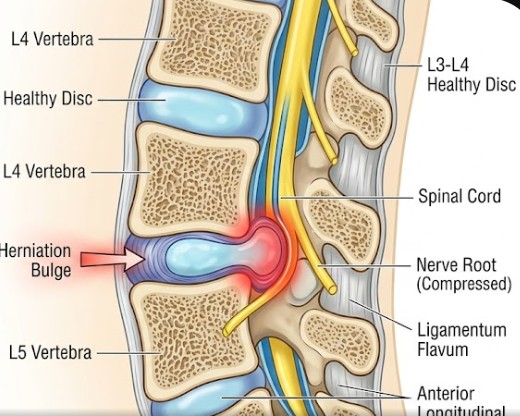
A bulging disk, also known as a disk protrusion, occurs when one of your spine’s cushioning disks weakens and expands outward, similar to a hamburger that’s too big for its bun. While still contained within its outer layer, the disk’s soft center pushes against its exterior, potentially pressing on nearby nerves.
In more detail, imagine your spine as a stack of building blocks (vertebrae), with specialized shock absorbers nestled between each block. These shock absorbers are your intervertebral discs, crucial for allowing you to bend, twist, and absorb the impact of daily activities. Each disc is a marvel of engineering, consisting of two key parts: a central, gel-like core called the nucleus pulposus, and a tough, fibrous outer ring known as the annulus fibrosus. Think of it like a jelly donut – the jelly in the middle is the nucleus, and the doughy part surrounding it is the annulus.
What Happens Mechanically with a Disk Protrusion?
Now, let’s delve into what happens in a disc protrusion, often referred to as a bulging disc. Over time, or due to specific injuries or repetitive strain, the annulus fibrosus can weaken or develop microscopic tears. When this happens, the nucleus pulposus, still contained within the weakened but intact outer layer, begins to press outwards. This outward pressure creates a bulge that extends beyond the normal circumference of the disc. It’s like the jelly in the donut pushing against the dough, causing it to swell outwards without actually breaking through.
This bulging is a significant stage in the spectrum of disc issues. It’s important to distinguish it from a herniated disc (also called a ruptured or slipped disc). In a herniation, the annulus fibrosus actually tears, allowing the nucleus pulposus to escape and leak out of its normal confines. While both conditions can exert pressure on nearby structures, the mechanism and potential severity differ. A protrusion represents an outward deformation, whereas a herniation involves the actual displacement of the disc material.
What is the Harm Caused by Disk Bulging (Disk Protrusion)?
The clinical significance of a disc protrusion lies in its potential to impinge upon the delicate spinal nerves that exit the spinal canal near the intervertebral discs. These nerves are responsible for transmitting signals between your brain and the rest of your body, controlling sensation and movement in your limbs. When a bulging disc presses against one of these nerves, it can lead to a variety of symptoms.
The most common symptom is pain, which can be localized in the back or neck, depending on the location of the affected disc. However, the pain can also radiate along the path of the compressed nerve. For instance, a bulging disc in the lower back can cause sciatica, a sharp, shooting pain that travels down the buttock and leg, sometimes reaching the foot. In addition to pain, nerve compression can also result in numbness, a loss of sensation in the affected limb, tingling, often described as a pins-and-needles sensation, and muscle weakness, making it difficult to perform certain movements. The specific symptoms experienced depend on which nerve is being compressed and the degree of compression.
Fortunately, not all disc protrusions cause noticeable symptoms. Some individuals may have bulging discs that are discovered incidentally during imaging tests for other reasons and never cause any pain or discomfort. However, when symptoms do arise, a range of treatment options are available.
Treatments for Disk Bulging (Disk Protrusion)
Initially, conservative management is typically the first line of defense. This may involve a period of rest to reduce inflammation, physical therapy to strengthen supporting muscles and improve posture, and pain medication, such as over-the-counter or prescription non-steroidal anti-inflammatory drugs (NSAIDs) or muscle relaxants, to alleviate pain and inflammation. In some cases, epidural steroid injections may be administered to directly deliver anti-inflammatory medication to the affected area around the spinal nerves.
If conservative treatments fail to provide adequate relief or if the symptoms are severe and significantly impacting the individual’s quality of life, more advanced treatments may be considered. These can include minimally invasive procedures or, in more complex cases, surgery to relieve the pressure on the affected nerve. The specific treatment approach is always tailored to the individual’s unique situation, considering the severity of their symptoms, the location and size of the protrusion, and their overall health.
Commonly, in vehicle accident cases you will see a progression of treatment from gentle chiropractic manipulations, physical therapy, exercise and stretching to more invasive procedures. The more invasive procedures can include injections, radio frequency ablation and, as a last resort, surgery.
About Michael Yates, D.C.
Michael Yates is a chiropractor who now works as a personal injury paralegal. We retain Dr. Yates’ company to review your medical records to be certain that your disk injuries are properly documented and treated. Many personal injury firms use AI to scan records but we believe that in many instances you need not just a human review but a review by a live person (Yates) who understands the mechanics of the spine and spinal injuries.
Call the Law Office of Daniel Horowitz for your accident case.
(925) 283-1863
THERE IS NO CHARGE FOR OUR INJURY CASE CONSULTATIONS AND NO FEE UNTIL YOU RECOVER MONEY